It's October 10 in Australia right now and that means it is world mental health day.
This is an annual initiative of the World Federation for Mental Health.
In Australia this year the campaign is based around the idea of people taking responsibility for their own mental health. The campaign slogan is "mental health begins with me".
It's main objectives are;
- encourage help seeking behaviour
- reduce the stigma associated with mental illness
- Foster connectivity through communities
Now, I do think the premise for this years campaign is somewhat problematic. It seems to take away from the seriousness of mental illness, by presenting it as something which can be controlled by the individual. I think the idea of taking responsibility for your own mental health can be very difficult for people already in the grips of a severe mental illness and can be very triggering for these people.
While I do not believe in taking all responsibility away from the individual, I think a campaign such as this should use less 'blaming' language. Mental illness is not your fault. It is no ones fault. Any efforts to reduce stigmatisation should make this point very clear.
People need to understand than no one chooses mental illness. It is not fun or glamorous. People with mental illness' are not trying to seek attention. They are ill. They are struggling and because of the stigma, they would much rather keep it hidden until it eats them alive. Literally.
I think the objectives of this campaign are great. Fostering connectivity through communities, encouraging help seeking behaviour and reducing stigma are excellent and much needed goals. However, when combined with the slogan "mental health begins with me" and the notion of encouraging people to take responsibility for their own mental health, I think it has a very damaging message. It suggests that people have control over whether or not they develop a mental illness or whether or not they recover. This is not always the case. Much of the time people are too scared or too damaged to seek help because of the stigma associated with having a mental illness.
More focus needs to be given to reducing the stigma, improving education and awareness and making mental health services more accessible.
As blogger, mental health activist and father to two children suffering severe mental illness, Michael Schofield wrote "we cannot go into their minds and 'fix' them. But we can fix the world so they can live in it." (January First, Prologue)
Until next time :) xx
Showing posts with label mental illness. Show all posts
Thursday, 10 October 2013
Sunday, 5 May 2013
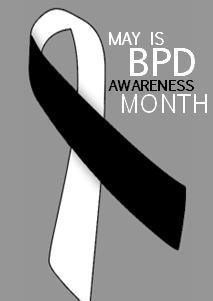
It's BPD awareness month!!
So it's officially May (I know, crazy right?!?) and that means it is Borderline Personality Disorder Awareness month.
BPD is a misunderstood and stigmatised mental illness characterised by instability in relationships and sense of self, intense feelings of loneliness or abandonment, intense fear of rejection, self-harm, impulsive and dangerous behaviour, intense anger and dissociative symptoms.
Until recently it was consider largely untreatable. People diagnosed with the disorder were shunned by the general public and psychiatric/medical community.
However, recently there has been much success in treating BPD through psychotherapy and Dialectic behavioural therapy.
The statistics are pretty scary.
10% of people with BPD, who seek treatment, will kill themselves (as opposed to around 6% of people with mood disorders such as depression).
A person with BPD is 9 1/2 times more likely to kill themselves than to recover fully.
While the symptoms can be treated there is no cure.
People with BPD are also more likely to be diagnosed with secondary mental illnesses such as Bipolar disorder, Complex Post Traumatic Stress Disorder and drug and alcohol abuse problems.
It is often difficult for family and friends of BPD sufferers to understand to what is going on. It can be challenging, frustrating and upsetting dealing with someone with BPD.
However the thing they need most is love and support. It's not easy to give your love and support to someone with BPD, at times they will push you away, tell you they hate you, insist that your hate them. They will get angry with you. They may seem like they are trying to manipulate you, but that is the illness, not the person.
With the right treatment, love and support, they can get through this. It will take time and patience but there is a light at the end of the tunnel.
It is worth sticking around for a BPD sufferer, they experience intense emotions and this gives them the ability to love more wholly and truly than others.
If someone you know has or might have BPD, give them a hug and try to understand.
If you have or might have BPD, stay strong, it will all be worth it in the end. There is hope. You can get through this.
If you would like to find out more about BPD I have compiled some good links below.
http://www.betterhealth.vic.gov.au/bhcv2/bhcarticles.nsf/pages/Borderline_personality_disorder
http://www.borderlinepersonalitydisorder.com.au
http://www.mifa.org.au/sites/www.mifa.org.au/files/documents/UnderstandingBorderlinePersonalityDisorder.pdf
Until next time :) xoxo
BPD is a misunderstood and stigmatised mental illness characterised by instability in relationships and sense of self, intense feelings of loneliness or abandonment, intense fear of rejection, self-harm, impulsive and dangerous behaviour, intense anger and dissociative symptoms.
Until recently it was consider largely untreatable. People diagnosed with the disorder were shunned by the general public and psychiatric/medical community.
However, recently there has been much success in treating BPD through psychotherapy and Dialectic behavioural therapy.
The statistics are pretty scary.
10% of people with BPD, who seek treatment, will kill themselves (as opposed to around 6% of people with mood disorders such as depression).
A person with BPD is 9 1/2 times more likely to kill themselves than to recover fully.
While the symptoms can be treated there is no cure.
People with BPD are also more likely to be diagnosed with secondary mental illnesses such as Bipolar disorder, Complex Post Traumatic Stress Disorder and drug and alcohol abuse problems.
It is often difficult for family and friends of BPD sufferers to understand to what is going on. It can be challenging, frustrating and upsetting dealing with someone with BPD.
However the thing they need most is love and support. It's not easy to give your love and support to someone with BPD, at times they will push you away, tell you they hate you, insist that your hate them. They will get angry with you. They may seem like they are trying to manipulate you, but that is the illness, not the person.
With the right treatment, love and support, they can get through this. It will take time and patience but there is a light at the end of the tunnel.
It is worth sticking around for a BPD sufferer, they experience intense emotions and this gives them the ability to love more wholly and truly than others.
If someone you know has or might have BPD, give them a hug and try to understand.
If you have or might have BPD, stay strong, it will all be worth it in the end. There is hope. You can get through this.
If you would like to find out more about BPD I have compiled some good links below.
http://www.betterhealth.vic.gov.au/bhcv2/bhcarticles.nsf/pages/Borderline_personality_disorder
http://www.borderlinepersonalitydisorder.com.au
http://www.mifa.org.au/sites/www.mifa.org.au/files/documents/UnderstandingBorderlinePersonalityDisorder.pdf
Until next time :) xoxo
Thursday, 13 September 2012
R U OK Day and my own personal torment
Today is R U OK Day. R U OK Day started in 2008 and occurs on the second Thursday in September every year.
In 2008 I was 16 and in year ten at high school. I had already been suffering depression for about 5 years, I hadn't been diagnosed yet and no one knew I was struggling. This post is not about my depression, it is about my experiences of R U OK Day, and how it has only had a negative impact on me.
On the second R U OK Day, I was in year 11, 17 years old, and more depressed than I had ever been. I never felt like I had any friends, and I thought no one cared. I had a group of 'friends' but I never really fit in. I was an outcast.
On R U OK Day that year, I was on a class excursion. The school had special programs on to celebrate the day, but because we weren't at school we didn't even know it was on.
Then I got a text message from a friend: "R U OKAY?"
I was so happy. I thought that friend was concerned about me. I thought she cared. I replied. "Yeah I'm great, I'm just on an excursion. Thanks for asking"
Well, she thought that was hilarious. So did everyone else at school. I became a joke. I didn't realise until someone else on excursion started complaining that everyone had been texting her 'R U OKAY'?
It was then I not only realised that my friend wasn't really interested in how I was, but also that I had only received one message, while everyone else had 20 or 30. It was a joke. Everyone thought it was hilarious.
Every year on R U OK Day, all day long people would ask everyone they saw "R U OK?" and everyone would laugh. How funny. What a silly day.
So I just wanted to say, R U OK Day is not a good idea. It is not helping. It is trivialising the issue of mental illness. Every year I dreaded that day. I knew what it was going to mean; pretending to be okay while everyone else laughed at how stupid it was to ask people if they were okay.
All I ever wanted was for someone to ask me if I was okay. Seriously, for real. Because I wasn't and I wanted someone to know, but nobody cared. Mental illness is not funny. It is not a sign of weakness and it is not a way of getting attention. It is serious and R U OK Day trivialises it beyond belief.
Subscribe to:
Posts (Atom)